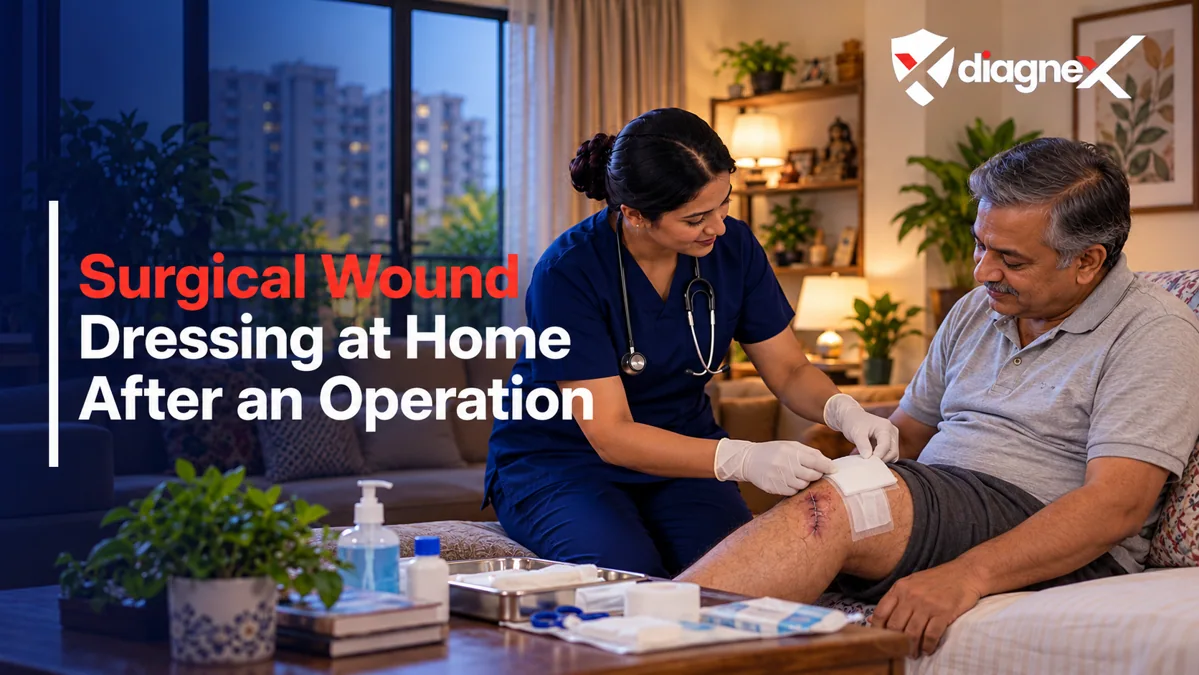
Wound dressing at home can be appropriate for selected patients who need regular wound care but do not need to travel to a hospital or clinic for every dressing change.
For related context, read Surgical Wound Dressing at Home an Operation and Wound Dressing at Home Cost: What Influences the Price?.
For related context, read Surgical Wound Dressing at Home an Operation and Wound Dressing at Home Cost: What Influences the Price?.
A trained nurse can assess the wound, remove the previous dressing, clean and protect the wound according to the treatment plan, apply the prescribed or clinically appropriate dressing, document changes and escalate concerns to the treating team.
But wound dressing is not simply “clean the wound and put on fresh gauze.”
Different wounds need different care.
A clean post-operative incision, a pressure injury, a diabetic foot ulcer, a draining chronic wound and a traumatic cut can have very different risks, dressing requirements and escalation thresholds.
Modern wound care also does not mean that every wound should be dried out or covered with the same sterile gauze every day. For many wounds, the goal is to protect the tissue, manage moisture and exudate, avoid contamination and create an environment that supports healing. NICE guidance for pressure ulcers, for example, recommends considering dressings that support a warm, moist wound-healing environment and choosing the dressing based on factors such as pain, wound position, exudate and change frequency.
The most useful question for families is therefore:
“What type of wound is this, what is the treatment plan, and what should the nurse watch for at each dressing change?”
This guide explains when wound dressing at home may be suitable, what the nurse does, how often dressings may need changing, what infection and bleeding signs matter, and when the wound needs specialist or hospital review.
The Short Answer: What Happens During Wound Dressing at Home?
A home wound-dressing visit may include: Confirming the wound-care instructions. Reviewing the patient’s symptoms and recent changes. Checking the old dressing and drainage. Assessing the wound and surrounding skin. Using appropriate hand hygiene and aseptic technique. Cleaning the wound as directed. Applying the appropriate primary and secondary dressing. Securing the dressing without unnecessary pressure. Documenting appearance, drainage and other findings. Explaining what the family should watch for. Escalating signs of infection, bleeding, tissue damage or delayed healing.
The exact process depends on: Wound type. Wound location. Whether the wound is surgical, traumatic or chronic. Depth. Drainage. Presence of sutures or staples. Infection risk. Underlying diabetes or vascular disease. Pressure risk. Treating-doctor or wound-team instructions.
What Does “Wound Dressing at Home” Mean?
Wound dressing at home means planned clinical wound care delivered in the patient’s residence by an appropriately trained nurse or other qualified professional.
It may be a one-time visit or a recurring service.
Home wound care can be especially useful when: The patient has limited mobility. The wound needs repeated dressing changes. The patient is recovering after surgery. Travel increases pain or difficulty. The patient is bedridden. A chronic wound is being followed under a treatment plan. A family needs a nurse to observe and document healing.
The home setting changes where the care happens.
It does not remove the need for clinical boundaries.
For the wider home-procedure framework, see What Are Clinical Procedures at Home? A Complete Guide.
Which Wounds May Be Suitable for Dressing at Home?
Suitability depends on the wound and patient.
Common home-care scenarios can include the following.
Post-Operative Wounds
A patient may need wound dressing after: Abdominal surgery. Orthopaedic surgery. Cardiac surgery. Minor surgery. Drain removal. Suture or staple placement. Another operation with a planned dressing schedule.
The hospital or surgeon should ideally provide: Wound instructions. Dressing type. Change frequency. Showering advice. Suture or staple plan. Follow-up date. Symptoms that require review.
Most uncomplicated surgical wounds can be supported at home after discharge when the patient is stable.
For post-discharge planning, see Clinical Procedures at Home After Hospital Discharge.
Pressure Injuries
Bedridden or mobility-limited patients can develop pressure injuries over areas such as: Sacrum. Hips. Heels. Ankles. Elbows. Other pressure points.
Wound dressing is only one part of pressure-injury management.
The plan may also require: Pressure redistribution. Repositioning. Nutrition assessment. Moisture management. Mobility support. Appropriate mattress or cushion. Assessment of depth and tissue damage.
NICE recommends documenting pressure-ulcer size and depth and selecting dressings based on clinical factors including pain, position, exudate and change frequency.
For the wider care context, see Clinical Procedures at Home for Bedridden Patients.
Diabetic Foot Ulcers
A diabetic foot wound should not be treated as a simple dressing problem.
NICE guidance recommends assessing and documenting: Site. Depth. Area. Infection. Ischaemia. Neuropathy.
Treatment may require: Offloading. Infection management. Circulation assessment. Debridement. Dressings. Multidisciplinary foot care.
A home nurse may continue dressing as part of an established plan.
But worsening diabetic foot wounds can require urgent specialist review.
Chronic Venous or Other Leg Ulcers
Some chronic leg wounds can be managed at home with a wound-care plan.
The plan may involve: Wound dressing. Exudate management. Skin care. Compression where appropriately assessed and prescribed. Mobility. Circulation assessment. Follow-up.
Compression should not be started casually without appropriate vascular assessment.
A chronic leg ulcer may fail to heal because of venous, arterial, diabetic or other underlying disease.
The nurse’s role is not only to replace the dressing but also to notice whether the wound is progressing.
Minor Traumatic Wounds
Some minor cuts, abrasions or superficial traumatic wounds may be suitable for home care after appropriate assessment.
More complex injuries may need: Suturing. Imaging. Foreign-body removal. Tetanus assessment. Rabies assessment where relevant. Surgical review. Hospital treatment.
A wound caused by a fall is different from a deep puncture wound or animal bite.
Selected Burns
Some minor burns can be dressed outside hospital after assessment.
More serious burns may require specialist care, particularly when they are: Deep. Large. Circumferential. Electrical. Chemical. On the face, hands, feet, genitals or major joints. Associated with inhalation injury. Present in a medically fragile patient.
A home nurse should not treat burn severity as a dressing-only question.
When Wound Dressing at Home May Not Be Appropriate
Hospital, surgical or specialist review may be safer when there is: Uncontrolled bleeding. A wound that is rapidly worsening. Severe or disproportionate pain. Deep tissue exposure. A wound that has opened substantially after surgery. Visible tendon, bone or deeper structures. Black or rapidly spreading dead tissue. Concern for severe infection. Fever with systemic deterioration. Rapidly spreading redness. Crepitus or severe swelling. A diabetic foot ulcer with infection or poor circulation. A limb that is cold, pale, blue or poorly perfused. A deep puncture or contaminated wound needing further assessment. A wound requiring surgical debridement. A large or deep burn. A wound with retained foreign material. A bite wound requiring medical prophylaxis. Another acute clinical concern.
For the broader setting decision, see When Should a Procedure Be Done at Home vs in a Hospital?
What Does the Nurse Assess During a Wound Dressing Visit?
A good wound visit involves observation, not just dressing replacement.
The nurse may assess: Wound location. Wound size. Depth where appropriate. Wound bed. Edges. Surrounding skin. Drainage or exudate. Drainage colour. Drainage amount. Odour. Pain. Bleeding. Swelling. Redness. Warmth. Sutures or staples. Signs of tissue breakdown. Signs of pressure. Patient temperature and other observations where relevant.
For chronic wounds, the nurse may also compare the wound with previous documentation.
MedlinePlus notes that wound-care teams assess and measure wounds, check factors that may affect healing and create an ongoing treatment plan.
Why the Old Dressing Matters
The previous dressing can provide useful information.
It may show: How much drainage has occurred. Whether blood is increasing. Whether the dressing was saturated. Whether leakage reached the edges. Whether there is unusual colour or odour. Whether the dressing remained secure. Whether the wound has been disturbed.
The old dressing should therefore not always be discarded before the nurse arrives when the clinician needs to assess drainage, unless the care plan says otherwise.
What Happens During a Nurse Visit for Wound Dressing?
The exact technique depends on the wound, but the high-level workflow usually includes the following.
1. The Nurse Confirms the Wound-Care Plan
The nurse may review: Discharge instructions. Surgeon’s advice. Prescription. Wound-clinic plan. Previous dressing notes. Current symptoms.
If instructions are unclear or the wound looks significantly different, the nurse may pause and seek clinical review.
2. The Procedure Area Is Prepared
A clean working area is created for: Dressings. Gloves. Cleansing supplies. Waste. Other ordered materials.
Home wound care should still follow infection-control principles.
3. Hand Hygiene Is Performed
Hand hygiene is central to wound-care safety.
The nurse performs hand hygiene before the procedure and at other points required by infection-control practice.
4. The Old Dressing Is Removed
The nurse observes: Drainage. Blood. Odour. Dressing saturation. Adhesive or skin damage.
The old dressing is disposed of appropriately.
5. The Wound Is Assessed
The wound and surrounding skin are inspected before a new dressing is placed.
This is the moment to identify: Increasing redness. Swelling. Pain. Separation. Dead tissue. Drainage. Other changes.
6. The Wound Is Cleaned According to the Plan
The cleaning method depends on the wound.
The nurse should follow the prescribed or clinically appropriate wound-care plan rather than automatically using a strong antiseptic on every wound.
7. The Appropriate Dressing Is Applied
The dressing choice depends on: Wound moisture. Drainage. Depth. Location. Skin condition. Infection status. Pain. Treatment goal.
A highly draining wound may need a different dressing from a clean, dry surgical incision.
8. The Dressing Is Secured
The dressing should remain: Secure. Comfortable. Appropriate for the wound. Not unnecessarily tight.
Fragile skin may require special attention to adhesives.
9. Findings Are Documented
Documentation may include: Wound appearance. Size where required. Drainage. Pain. Dressing used. Patient response. Concerns. Escalation or follow-up.
10. The Family Receives Aftercare Guidance
The family should know: When the next change is due. Whether the dressing must stay dry. What leakage is acceptable. Which signs require a call. Which symptoms require urgent assessment. For more on the practical service arrangements, review wound care at home before deciding what information the care team needs.
For the broader home-visit workflow, see How Does a Nurse Visit for a Home Procedure Work?
Does Every Wound Need a “Sterile Dressing”?
No.
“Sterile dressing” is often used as a general phrase, but wound-care technique depends on the wound, setting and clinical plan.
Some procedures require sterile supplies and a sterile field.
Others use an aseptic non-touch technique with appropriate clean or sterile materials.
The underlying principle is to prevent contamination of the wound and dressing components that should remain aseptic.
WHO wound-management guidance emphasises aseptic technique for wound dressing and the importance of a clean environment and hand hygiene.
The safest approach is not to ask whether the dressing is simply “sterile.”
Ask: What technique does this wound require? Which dressing material is appropriate? How is contamination prevented? Is the wound being assessed as well as covered?
For broader infection-control principles, see How Infection Control Works During a Clinical Procedure at Home.
How Is the Dressing Type Chosen?
The dressing should match the wound.
Factors can include: Moisture level. Amount of exudate. Depth. Presence of slough or necrotic tissue. Wound location. Skin fragility. Pain. Infection risk. Need for protection from pressure or friction. Frequency of dressing change.
Dressings can include different categories such as: Simple island dressings. Foam dressings. Absorbent dressings. Alginate or gelling-fibre dressings. Hydrocolloid products. Hydrogel products. Antimicrobial dressings when clinically indicated. Other specialist products.
The family should not choose a dressing only because it is “stronger,” “more expensive” or advertised as faster healing.
The wound assessment should drive the choice.
How Often Should a Wound Dressing Be Changed?
There is no universal schedule.
A dressing may need changing: Daily. Every few days. More frequently if drainage is high. Less frequently when a modern dressing can safely remain in place. According to a post-operative protocol. According to a wound-clinic plan.
Guy’s and St Thomas’ NHS guidance notes that some surgical dressings can remain in place for several days, with earlier replacement when the dressing becomes loose, soaked or drainage reaches the edges.
The correct frequency depends on: Wound. Dressing type. Drainage. Infection. Healing stage. Clinician instructions.
Changing a dressing too often can disturb healing tissue.
Leaving a saturated or failed dressing in place can also create problems.
The goal is the right interval, not the most frequent interval.
When Should a Dressing Be Changed Earlier Than Planned?
Contact the nurse or change the dressing according to the care plan if it becomes: Soaked through. Wet. Loose. Dirty. Displaced. Contaminated. Associated with increasing pain or leakage.
A dressing that no longer protects the wound is not doing its job.
The response still depends on the wound and dressing type.
Some advanced dressings are designed to absorb substantial drainage and remain in place longer than simple gauze.
The nurse should explain what level of staining or drainage is expected and when the dressing has clearly failed.
Can the Dressing Get Wet?
This depends on the wound and dressing.
Some modern dressings are water resistant.
Others should be kept dry.
For post-operative wounds, the discharge instructions should guide showering and bathing.
In general: Avoid soaking a fresh wound unless the treating team says it is safe. Do not submerge a wound in bath water unless specifically advised. Protect dressings that are not designed to get wet. Contact the nurse if the dressing becomes soaked or loses adhesion.
The patient should not assume that a waterproof outer layer means the wound itself can be immersed safely.
How Should Pain Be Managed During Dressing Changes?
Some wounds are painful, especially when: The dressing sticks. The wound is inflamed. There is exposed tissue. The wound is deep. Infection is present. Debridement is required.
Pain should be anticipated rather than ignored.
The treating team may recommend: Analgesia before the dressing. A different dressing material. A less adherent contact layer. A different change frequency. Further wound assessment.
Severe or increasing pain can also be a warning sign.
Pain that is disproportionate to the wound appearance, rapidly worsening or accompanied by systemic symptoms needs medical review.
What Is Debridement?
Debridement is the removal of dead, damaged or contaminated tissue from a wound.
It can be performed in different ways, including: Sharp or surgical debridement. Mechanical methods. Autolytic methods using appropriate dressings. Other specialist approaches.
Debridement is not the same as routine wound cleaning.
Some forms require: A doctor. A wound specialist. A trained nurse with appropriate competency. A clinic or hospital.
Families should not attempt to cut away dead tissue at home.
When a wound has significant necrotic tissue, the treatment plan should identify who is responsible for debridement.
Should Antiseptic Be Used on Every Wound?
No.
A strong antiseptic is not automatically necessary for every dressing change.
The cleansing method depends on: Wound type. Infection status. Surgical instructions. Treating-team plan.
Some wounds may be cleansed with an appropriate sterile solution.
Others may have different instructions.
Using harsh products without a clinical reason can irritate tissue or interfere with healing.
The nurse should follow the wound-care plan rather than using the same antiseptic on every patient.
Should Antibiotic Cream Be Applied to Every Wound?
No.
Topical antibiotics are not routine for every wound.
They may be appropriate in selected situations under a clinical plan.
Unnecessary antibiotic use can: Cause skin reactions. Contribute to antimicrobial resistance. Delay recognition of a deeper infection. Create false reassurance.
If infection is suspected, the patient may need assessment rather than simply adding an antibiotic cream.
How Do You Know if a Wound Is Healing?
Signs of progress can include: Reduced wound size. Healthier-looking tissue. Less drainage. Less pain. Reduced swelling. Improvement in surrounding skin. No new tissue breakdown.
Some wounds heal slowly.
The speed depends on: Wound type. Blood supply. Diabetes control. Nutrition. Pressure. Smoking. Infection. Medication. Age. Other illnesses.
A chronic wound that is not improving should be reassessed rather than repeatedly dressed in the same way indefinitely.
What Are Signs of Wound Infection?
Possible signs include: Increasing redness. Increasing warmth. Increasing swelling. Increasing pain. Pus or cloudy drainage. Unpleasant odour. Wound breakdown. Fever. Chills. General deterioration.
Not every increase in drainage means infection.
Some chronic wounds naturally produce significant exudate.
The pattern matters.
A sudden change from the wound’s usual appearance or drainage is more concerning than one isolated finding.
When Infection Needs Urgent Review
Urgent medical assessment may be needed when there is: Rapidly spreading redness. High fever with deterioration. Severe pain. Low blood pressure. Confusion. Breathing difficulty. Red streaking. Black or rapidly dying tissue. Severe swelling. Concern for sepsis. A diabetic foot wound with worsening infection.
Home dressing should not delay medical treatment of a serious wound infection.
What if the Wound Is Bleeding?
A small amount of blood can occur during some dressing changes.
More concerning bleeding includes: Persistent bleeding. Dressing rapidly soaking with blood. Pulsatile bleeding. Bleeding associated with dizziness or weakness. Bleeding in a patient on anticoagulants that does not stop with appropriate pressure.
These situations may need urgent review.
A nurse should not continue routine dressing if significant uncontrolled bleeding is present.
What if a Surgical Wound Opens?
A surgical wound that separates can require prompt assessment.
The significance depends on: How much the wound has opened. Depth. Drainage. Bleeding. Pain. Presence of infection. Whether deeper tissue is visible.
Do not simply pull the edges together and cover the wound without review.
Contact the surgeon, treating team or appropriate clinical service.
A large dehiscence or visible deeper tissue may require urgent hospital assessment.
What if There Is Pus or Bad Smell?
Pus, increasing odour or a sudden change in drainage can suggest infection or tissue breakdown.
However, odour can also come from: Old dressing material. Heavy exudate. Certain wound types. Necrotic tissue.
The nurse should assess the wound rather than treating smell alone.
If pus is present or the patient has fever, increasing pain, spreading redness or systemic symptoms, medical review may be needed.
What if the Dressing Is Stuck to the Wound?
A dressing should not be ripped off forcefully.
Adherent dressings can cause: Pain. Bleeding. Damage to new tissue.
The nurse should remove the dressing according to the wound-care protocol.
If a dressing repeatedly sticks, the dressing choice may need review.
The goal is to protect healing tissue, not repeatedly traumatise it.
Wound Dressing for Diabetic Patients
Diabetes can slow wound healing and increase infection risk.
A diabetic patient may also have: Reduced sensation. Poor circulation. Kidney disease. Higher risk of foot complications.
A diabetic foot wound needs more than dressing.
It may require: Foot examination. Infection assessment. Circulation assessment. Offloading. Glucose management. Specialist foot care.
Any new diabetic foot ulcer, blackening, rapidly spreading infection or poor circulation requires timely specialist review.
For elderly-specific home-care considerations, see Clinical Procedures at Home for Elderly Patients.
Wound Dressing for Bedridden Patients
Bedridden patients may develop wounds because of: Pressure. Moisture. Friction. Immobility. Poor nutrition. Medical devices.
Dressing alone is not enough.
The care plan may also need: Repositioning. Pressure-relieving mattress. Heel protection. Skin checks. Nutrition support. Moisture management. Mobility or physiotherapy.
For the wider care plan, see Clinical Procedures at Home for Bedridden Patients.
Post-Operative Wound Dressing at Home
After surgery, home dressing may be appropriate when: The patient is stable. The wound plan is clear. There is no major bleeding. There is no major wound separation. The patient knows the follow-up schedule.
The nurse may need to monitor: Wound edges. Drainage. Redness. Swelling. Pain. Sutures or staples. Any drains that remain.
The surgeon’s instructions should take priority over a generic dressing routine.
Can Sutures or Staples Be Removed at Home?
Sometimes, if: The treating clinician has confirmed the timing. The wound has been assessed. An appropriately trained nurse performs the removal. The wound appears sufficiently healed.
Suture or staple removal should not be based only on a calendar date without checking the wound.
A wound under tension or healing poorly may need medical review before removal.
What Supplies May Be Needed for Home Wound Dressing?
Depending on the wound: Appropriate dressing. Cleansing solution. Gauze. Absorbent pads. Adhesive or fixation material. Gloves. Waste bag. Skin-protection products. Other wound-specific items.
The exact supplies should match the plan.
Families should ask whether the provider brings: Standard materials. Only the nurse. Specialist dressings. Additional wound products.
A specialised dressing can affect visit cost.
What Should Families Prepare Before the Nurse Arrives?
Useful preparation can include: Discharge or wound instructions. Current dressing products. List of medicines. Information about diabetes or blood-thinner use. A clean working surface. Good lighting. Access to the wound. Recent wound photographs only if the treating team uses them for comparison. Any previous wound notes.
Do not remove the old dressing in advance unless the care plan specifically asks you to.
The nurse may need to assess the drainage on it.
How Long Does a Wound Dressing Visit Take?
There is no fixed duration.
A simple surgical dressing may be brief.
A complex chronic wound may take longer because of: Assessment. Cleaning. Multiple dressings. Heavy drainage. Pain. Positioning. Documentation. Pressure-injury care. Need to contact the treating team.
The visit length should reflect the wound, not an arbitrary standard slot.
Short Visit vs Full-Shift Nursing for Wound Care
Many dressing changes fit a short nursing visit.
A longer nursing model may be more appropriate when the patient also needs: Multiple wound dressings. Frequent repositioning. Catheter care. Tube feeding. Medication administration. Monitoring. Tracheostomy care. Other repeated procedures.
For this decision, see Short-Visit Nurse vs Full-Shift Nurse: Which One Is Needed?
How Much Does Wound Dressing at Home Cost?
Cost can vary with: Wound complexity. Visit duration. Number of wounds. Dressing materials. Specialist products. Need for debridement or specialist review. Locality. Urgency. Repeat visits.
A provider should clarify whether: Nursing charge is separate. Dressings are included. Consumables are billed separately. Specialist wound products are extra.
The cheapest visit may not be the cheapest care if the wrong dressing is repeatedly used.
When Should the Treatment Plan Be Reassessed?
Reassessment is important when: The wound is not getting smaller. Drainage increases. Pain increases. Redness spreads. The wound deepens. New dead tissue appears. The wound repeatedly breaks down. The dressing becomes saturated too quickly. The same pressure injury recurs. The diabetic wound is not improving.
A chronic wound that is not progressing needs clinical review.
Repeatedly replacing the same dressing without asking why healing has stalled can waste time and delay appropriate care.
What About Tetanus After a New Wound?
Some traumatic wounds may require tetanus vaccination review.
CDC wound-management guidance recommends assessing: Wound type. Vaccination history. Need for tetanus vaccination. Whether tetanus immune globulin is indicated for certain high-risk wounds.
Families should tell the treating professional when: The wound is dirty or contaminated. It is a puncture wound. The vaccination history is uncertain. The last tetanus dose was many years ago.
A nurse dressing the wound should not assume vaccination is up to date.
What About Animal Bites?
Animal bites can require: Wound cleaning. Tetanus assessment. Rabies risk assessment. Antibiotic review. Medical or surgical assessment.
A dog, cat, monkey or other mammal bite in India should not be handled as a dressing-only request.
Timely rabies assessment can be critical.
Seek medical care promptly.
What Should You Ask Before Booking a Nurse for Wound Dressing?
Ask: What type of wound is it? Was the patient seen by a doctor? Is there a discharge or wound plan? When was the wound created or operated on? Is there active bleeding? Is there fever? Is there increasing redness or swelling? Is the patient diabetic? Is the patient on blood thinners? Is there a pressure injury? Which dressing was last used? Are specialist dressing materials required? How often is the dressing meant to change? When is the next surgical or wound-clinic review?
These questions help the provider arrange the right nurse and supplies.
How Diagnex Should Handle Wound Dressing Enquiries
A wound-dressing enquiry should be triaged before it is treated as a routine nurse visit.
Diagnex should confirm: Wound type. Location. How long it has been present. Whether it is post-operative, traumatic or chronic. Current dressing plan. Presence of diabetes. Presence of pressure injury. Bleeding. Pain. Redness. Swelling. Drainage. Fever. Current wound products. Treating-doctor or hospital instructions. Local professional availability.
If there is uncontrolled bleeding, severe infection, major wound separation, black tissue, poor circulation or another high-risk feature, the patient should be directed toward appropriate medical review rather than routine dressing alone. If the family is considering support at home, the Diagnex guide to home nursing explains the service pathway and its limits.
If the family is unsure which service fits, use Find the Right Care.
For wound care after discharge, read Clinical Procedures at Home After Hospital Discharge.
For infection-control principles, read How Infection Control Works During a Clinical Procedure at Home.
For the general safety framework, read Home Clinical Procedure Safety Checklist for Families.
Frequently asked questions
Can wound dressing be done at home?
Yes. Many uncomplicated post-operative, chronic and selected traumatic wounds can be dressed at home when the patient is stable and there is an appropriate wound-care plan.
Does every wound need a sterile dressing?
No. The required technique and dressing depend on the wound. The goal is appropriate aseptic care and the correct dressing, not simply using the word “sterile.”
How often should a wound dressing be changed?
It depends on the wound, dressing type, drainage and treatment plan. Some dressings need daily changes; others can remain for several days.
What are signs of wound infection?
Increasing redness, warmth, swelling, pain, pus, worsening drainage, fever or clinical deterioration can indicate infection.
Can a nurse change a surgical dressing at home?
Yes, selected post-operative wounds can be managed by a trained home nurse when the surgeon’s or hospital’s wound plan is clear.
Can a diabetic foot ulcer be dressed at home?
It can be dressed at home as part of a treatment plan, but diabetic foot wounds need assessment for infection, circulation, neuropathy and offloading. Dressing alone is not sufficient.
What if the dressing becomes soaked?
Contact the nurse or follow the wound plan. A soaked or failed dressing may need earlier replacement.
Can a wound be cleaned with antiseptic every day?
Not automatically. The cleaning solution should match the wound and clinical plan. Strong antiseptics are not appropriate for every wound.
When should a wound be taken to hospital?
Urgent review may be needed for uncontrolled bleeding, severe infection, rapidly spreading redness, major wound opening, exposed deeper tissue, severe pain, poor circulation or systemic deterioration.
Can sutures be removed at home?
Sometimes, when the treating clinician has confirmed timing and a trained professional assesses that the wound is ready.
The Bottom Line
Wound dressing at home can be safe, practical and clinically useful for selected patients.
But good wound care is not simply replacing gauze.
A proper visit should answer: What type of wound is this? Is it improving? What is the drainage pattern? Is infection developing? Is the dressing still appropriate? Is pressure, diabetes or poor circulation affecting healing? Does the patient need escalation rather than another routine dressing?
The best home wound-care plan combines: Correct dressing selection. Appropriate infection-control technique. Regular wound assessment. Pressure and moisture management where relevant. Clear follow-up. Timely specialist or hospital escalation.
The dressing protects the wound.
The assessment protects the patient.
Sources and Medical References
NICE: Pressure ulcers, prevention and management, including wound assessment and dressing selection principles. NICE: Diabetic foot problems, assessment, infection, ischaemia, neuropathy and multidisciplinary treatment principles. Guy’s and St Thomas’ NHS Foundation Trust: Surgical wound care, dressing duration, leakage and post-operative wound guidance. MedlinePlus: Wound care centres, wound assessment, measurement and treatment planning. CDC: Clinical Guidance for Wound Management to Prevent Tetanus, wound classification and tetanus vaccination assessment. WHO: Wound management guidance, hand hygiene, aseptic practice and wound-dressing principles. This article provides general health information and is not a substitute for patient-specific medical advice, diagnosis or treatment. Dressing selection, frequency, debridement and treatment of complex or infected wounds should follow an appropriately qualified clinical professional’s plan.
What Does Normal Healing Look Like?
Wounds do not all heal in the same way.
Depending on the wound, normal healing may include: Gradual reduction in size. Less drainage over time. Healthy pink or red granulation tissue. Reduced swelling. Less pain. Edges gradually coming together. Formation of new skin.
Some wounds heal quickly.
Others, especially pressure injuries, diabetic foot ulcers and venous ulcers, may take weeks or months.
The important question is whether the wound is progressing in the right direction.
What Are Signs of Wound Infection?
Possible signs include: Increasing pain. Increasing redness. Warmth. Swelling. Pus or cloudy drainage. New unpleasant odour. Fever. Chills. Wound edges breaking down. Increasing drainage. Delayed healing. General deterioration.
NHS and MedlinePlus patient guidance both advise medical review for increasing pain, redness, swelling, drainage or fever after wound care.
Not every red wound is infected.
But progressive redness plus pain, warmth, swelling or systemic symptoms deserves review.
When Does Wound Redness Become More Concerning?
Mild local redness can occur around some healing wounds.
More concerning patterns include: Redness spreading away from the wound. Increasing warmth. Increasing tenderness. Red streaking. Swelling. Pus. Fever. Rapid change from the previous dressing visit.
A nurse should document and escalate progressive changes rather than simply covering them with a new dressing.
What Does Wound Drainage Mean?
Drainage can be part of normal healing.
Its significance depends on: Amount. Colour. Thickness. Odour. Change over time.
Drainage may be: Clear or pale. Blood-stained. Serous. Thicker or cloudy. Purulent.
A sudden increase in drainage or a change to foul-smelling, thick or pus-like fluid may require review.
The dressing should be able to manage the expected amount of exudate without remaining saturated against the skin.
What if the Dressing Becomes Soaked?
A dressing that becomes saturated may need earlier replacement.
Soaking can occur because of: High wound exudate. Bleeding. A dressing that is too small or not absorbent enough. Worsening infection. Another change in the wound.
If dressings repeatedly soak through, the treatment plan should be reassessed rather than simply changing the same dressing more often.
What if the Wound Starts Bleeding?
A small amount of blood may occur during some dressing changes, especially with fragile granulation tissue.
More concerning bleeding includes: Bleeding that does not stop with appropriate pressure. Rapid saturation of the dressing. Large amounts of fresh blood. Bleeding associated with dizziness or weakness. Bleeding in a patient taking anticoagulants. Bleeding after recent surgery.
Uncontrolled bleeding requires urgent medical assessment.
In India, call 112 or go to the nearest appropriate emergency facility when emergency care is required.
What if a Surgical Wound Opens?
Wound separation after surgery is called dehiscence.
A small superficial gap may need review by the surgical team.
A larger opening can be more serious, especially if: Deeper tissue is visible. There is active bleeding. Abdominal contents or deeper structures are exposed. The patient has severe pain. There is fever or infection. The wound opened suddenly.
Do not simply pull the edges together with household tape.
Contact the surgical team or seek urgent assessment based on severity.
Should Families Clean the Wound Themselves Between Nurse Visits?
Sometimes simple wound-care tasks may be taught to patients or caregivers.
But this depends on: Wound type. Dressing. Patient capability. Infection risk. Treating-team plan.
Families should not: Probe the wound. Scrape tissue. Cut dead tissue. Use strong antiseptics without instruction. Apply powders or herbal products. Put non-prescribed creams inside the wound. Reuse old dressings.
If the care team expects family dressing changes, the technique and supplies should be taught explicitly.
What Is Debridement?
Debridement means removal of dead, damaged or contaminated tissue to support wound healing.
Methods can include: Sharp or surgical debridement. Autolytic debridement using appropriate dressings. Enzymatic methods. Other specialist approaches.
Debridement is not the same as routine dressing.
A home nurse should not perform advanced debridement beyond professional scope and the treatment plan.
Wounds with extensive dead tissue, deep infection or uncertain anatomy may need specialist wound or surgical review.
Can a Nurse Remove Sutures or Staples at Home?
Sometimes, when: The surgeon or treating team has authorised removal. The correct date or healing stage has been reached. The wound appears suitable. An appropriately trained professional is available.
The nurse should not remove sutures simply because a certain number of days has passed if the wound appears unstable.
If there is: Wound separation. Infection. Unexpected swelling. Poor healing.
the surgical team may need to review first.
Can a Nurse Change a Dressing Around a Drain?
Sometimes.
Post-operative drains may require: Site dressing. Drain-output monitoring. Tube fixation. Specific cleaning. Documentation.
The drain itself should be managed according to the surgical plan.
A nurse should not remove a surgical drain without the appropriate order or protocol.
What About Negative Pressure Wound Therapy?
Negative pressure wound therapy uses a sealed dressing connected to a suction device.
It may be used for selected complex wounds.
Home management can be possible in structured programmes.
It requires: Appropriate wound selection. Specific dressing technique. Device management. Seal checks. Monitoring. Planned dressing changes. Escalation for bleeding, pain or device failure.
This is not a standard gauze-dressing service.
The provider should confirm that the nurse is trained for the specific device and wound plan.
Why Pressure Relief Matters for Bedsores
A pressure injury will not improve reliably if the same pressure continues.
The patient may need: Repositioning. Pressure-relieving mattress. Heel protection. Cushions. Mobility work. Moisture management. Nutrition support.
NICE pressure-ulcer guidance emphasises pressure redistribution as part of management.
The dressing protects the wound.
It does not replace offloading.
How Often Should a Bedridden Patient Be Repositioned?
There is no single schedule for every patient.
The plan depends on: Skin condition. Mobility. Pressure risk. Mattress. Nutrition. Medical stability. Existing pressure injuries.
The nursing or wound-care team should set the turning and pressure-relief plan.
For broader bedridden care, see Clinical Procedures at Home for Bedridden Patients.
Why Diabetic Foot Wounds Need Extra Caution
Diabetes can affect: Sensation. Circulation. Immune response. Healing.
A patient may have significant tissue damage without severe pain because neuropathy reduces sensation.
Urgent review may be needed for: New swelling. Redness. Pus. Black tissue. Fever. A hot swollen foot. New deformity. Poor circulation. Rapid deterioration.
NICE recommends urgent specialist pathways for diabetic foot problems, especially when infection, ischaemia or deep tissue involvement is present.
A diabetic foot ulcer should not be managed indefinitely through repeated dressing visits without appropriate medical and foot-care review.
What Is Offloading?
Offloading means reducing pressure on a wound, especially a diabetic foot ulcer.
This may involve: Special footwear. Boots. Casts. Pressure-relieving devices. Changes in weight bearing.
The exact method should come from the diabetic-foot or specialist team.
A good dressing cannot compensate for continued pressure on the ulcer.
What About Venous Leg Ulcers and Compression?
Venous ulcers may benefit from compression when appropriate.
But compression is not simply a tighter bandage.
Before compression, the care team may need to assess arterial circulation.
If significant arterial disease is present, inappropriate compression can be harmful.
A home nurse should follow the vascular or wound-care plan rather than starting strong compression based only on leg swelling or an ulcer diagnosis.
What if the Wound Has Black Tissue?
Black tissue can represent: Dry eschar. Necrosis. Other tissue changes.
Its significance depends on: Location. Blood supply. Infection. Depth. Underlying condition.
Not every black area should be removed at home.
For example, certain dry stable heel eschars may be managed differently from infected necrotic tissue.
The wound should be clinically assessed before debridement decisions are made.
What if the Wound Smells Bad?
Odour can come from: Heavy exudate. Dead tissue. Certain dressings. Colonisation. Infection.
A new strong or worsening odour, especially with: Pain. Pus. Redness. Swelling. Fever.
should prompt clinical review.
Odour-masking products should not replace assessment of the cause.
Does Every Infected-Looking Wound Need Antibiotics?
No.
Antibiotics should be used when there is a clinical indication.
Some wounds may be colonised with bacteria without having an invasive infection requiring systemic antibiotics.
The treating professional should decide whether the patient needs: Local wound care. Culture. Systemic antibiotics. Drainage. Debridement. Another intervention.
NICE pressure-ulcer guidance advises against using systemic antibiotics solely to heal a pressure ulcer without clinical evidence of infection.
Families should not restart leftover antibiotics because a wound looks worse.
Should a Wound Be Swabbed?
Sometimes.
A wound swab may be appropriate when: Clinical infection is suspected. The result may change treatment. The treating team requests it.
Routine swabbing of every wound is not always useful.
The decision depends on the wound and clinical context.
Can Wound Dressing Be Painful?
Some wounds are painful.
Pain can occur during: Removal of an adhered dressing. Cleaning. Movement. Packing. Pressure. Exposure of sensitive tissue.
The care plan can sometimes reduce pain by: Using a less-adherent dressing. Moistening certain dressings before removal where appropriate. Scheduling prescribed analgesia before the visit. Using gentler adhesive products. Changing technique or dressing type.
New or sharply worsening pain can also signal infection, ischaemia or another complication and should not be dismissed as “normal dressing pain.”
Can Pain Medicine Be Taken Before Dressing?
Sometimes, if it is already prescribed or considered appropriate by the treating team.
For a patient with predictable dressing-related pain, timing analgesia before the visit may help.
The nurse should not independently prescribe new pain medicine.
Pain that is severe or disproportionate should trigger clinical reassessment.
Can the Patient Shower With a Wound Dressing?
This depends on: Wound. Dressing type. Surgical instructions. Whether the dressing is waterproof.
Some dressings can tolerate showering.
Others must stay dry.
Submerging a wound in a bath, pool or other water may be restricted until healing is adequate.
The care team should provide wound-specific bathing advice.
What if the Dressing Gets Wet?
If the dressing is not designed for wet exposure and becomes soaked, it may need replacement.
Moisture can: Loosen the dressing. Macerate surrounding skin. Increase contamination risk.
Contact the nurse when the dressing becomes wet, loose or contaminated, particularly for a recent surgical wound or complex chronic wound.
What Is Skin Maceration?
Maceration happens when skin stays too wet.
The surrounding skin may become: White. Soft. Wrinkled. Fragile. Easily damaged.
This can occur when: Exudate is high. The dressing cannot absorb enough. The dressing leaks. Moisture remains against the skin.
The nurse may need to adjust: Dressing type. Change frequency. Skin protection.
The goal is moisture balance, not simply adding more gauze.
Why Nutrition Matters for Wound Healing
Healing requires energy and nutrients.
Factors that may affect healing include: Low protein intake. Poor overall nutrition. Vitamin or mineral deficiencies. Dehydration. Uncontrolled diabetes. Severe illness.
Patients with chronic or complex wounds may need nutrition assessment.
Supplements should be based on individual need rather than assuming every wound requires a commercial protein product.
Why Blood Sugar Control Matters
High blood glucose can impair wound healing and increase infection risk.
For patients with diabetes, the wound-care plan may need to coordinate: Glucose monitoring. Medicines. Diet. Foot care. Infection treatment. Circulation assessment. For care planning beyond this article, compare surgery dressing at home with the instructions already given by the treating professional.
Repeated wound dressing without attention to diabetes control may be insufficient.
Why Circulation Matters
A wound cannot heal normally without adequate blood supply.
Poor circulation may cause: Cold skin. Pale or bluish colour. Pain. Slow healing. Tissue loss. Weak pulses.
A chronic foot or leg wound with poor perfusion may require vascular assessment.
Home dressing should not delay investigation of suspected ischaemia.
When Should Tetanus Status Be Reviewed?
Tetanus vaccination status can matter after some traumatic wounds.
CDC advises assessing wound type and vaccination history as part of tetanus prevention.
Higher-risk wounds can include: Puncture wounds. Wounds contaminated with soil, faeces or saliva. Crush injuries. Burns. Necrotic wounds. Certain bites.
The appropriate vaccine or immune-globulin decision depends on the wound and immunisation history.
A home nurse should escalate this question to an appropriate medical professional rather than assuming a dressing alone is sufficient.
What About Animal or Human Bites?
Bite wounds can have additional risks.
They may require: Thorough assessment. Tetanus review. Rabies assessment depending on exposure. Antibiotic consideration. Surgical review. Management of deeper tissue injury.
A bite wound should not be treated as a routine dressing request without appropriate medical assessment.
When Should a Wound Be Photographed?
Wound photography can help track healing when used appropriately.
If photographs are part of the care plan: Patient consent matters. Images should be handled securely. A consistent perspective can help comparison. Measurements and clinical documentation still matter.
Families should not post wound photographs in informal messaging groups without considering privacy.
The home-care provider should use an appropriate clinical documentation process.
What Supplies May Be Needed for Home Wound Dressing?
Depending on the plan: Primary dressing. Secondary absorbent dressing. Gauze. Cleansing solution. Gloves. Tape or fixation. Skin barrier. Waste bag. Other wound-specific products.
Complex wounds may require: Foam products. Alginate. Specialised antimicrobial dressings. Packing material. Compression products. Negative-pressure supplies.
The provider should confirm who supplies the materials.
Families should avoid substituting household cotton, tissues or non-medical materials into a prescribed wound-care plan.
How Should Dressing Supplies Be Stored?
Keep supplies: Clean. Dry. Protected from dust. Away from pets. Away from children. Within expiry. In intact packaging.
Do not use: Opened sterile products that have become contaminated. Damaged packs. Expired items.
A clean storage box or cupboard can help keep supplies organised between visits.
How Long Does a Wound Dressing Visit Take?
Duration depends on: Wound number. Wound size. Depth. Old dressing complexity. Need for irrigation or cleaning. Drainage. Patient mobility. Pain. Need for documentation. Need for multiple dressing products.
A straightforward post-operative dressing can be relatively brief.
A complex pressure injury or multiple wounds can take much longer.
The service should be booked against the actual wound requirement rather than assuming every dressing is a short standard visit.
Can Wound Dressing Be a Short Nurse Visit?
Often, yes, for a stable patient with: One uncomplicated wound. Clear instructions. Straightforward dressing. Limited monitoring needs.
Longer nursing coverage may be more appropriate when the patient has: Multiple wounds. Large pressure injuries. Complex devices. Several procedures. Tube feeding. Catheter care. High dependency. Frequent repositioning needs.
For the staffing comparison, see Short-Visit Nurse vs Full-Shift Nurse: Which One Is Needed?
How Much Does Wound Dressing at Home Cost?
Cost can depend on: Nurse visit duration. Number of wounds. Wound complexity. Dressing type. Consumables. Location. Urgency. Frequency of visits. Whether advanced wound products are needed. Whether another nursing procedure is performed at the same visit.
A simple gauze dressing and a complex pressure-ulcer dressing should not be expected to cost the same.
Families should ask whether: Dressings are included. Specialist products are separate. Travel is included. Repeat-course pricing applies.
What Should Families Ask Before Booking a Nurse for Wound Dressing?
Ask: What type of wound is it? Was it assessed by a doctor or wound team? When was the last dressing changed? What dressing is currently being used? Is there a written wound-care plan? Is there increasing pain? Is there fever? Is there redness or swelling? How much drainage is present? Is there pus or strong odour? Is the wound bleeding? Does the patient have diabetes? Is this a pressure injury? Is circulation poor? Are sutures, staples or a drain present? Who supplies the dressing materials? How often is dressing required? When is the next doctor or surgical review?
These questions help the provider send the right nurse and supplies.
How Diagnex Should Handle Wound Dressing Enquiries
Diagnex should first determine: Wound type. Location. Cause. How long the wound has been present. Whether the patient was recently discharged. Whether there is a written dressing plan. Current dressing type. Drainage. Pain. Redness. Swelling. Fever. Bleeding. Diabetes. Mobility. Pressure risk. Circulation concerns. Presence of sutures, staples or drains. Whether debridement or specialist care has been recommended.
A wound with: Uncontrolled bleeding. Rapidly spreading infection. Severe pain. Deep tissue exposure. Major dehiscence. Significant diabetic-foot concern. Poor circulation. Severe burn. Another acute red flag
should be triaged beyond a routine dressing visit.
If the family is unsure which service fits, use Find the Right Care.
For the general procedure workflow, read How Does a Nurse Visit for a Home Procedure Work?
For infection control, read How Infection Control Works During a Clinical Procedure at Home.
For post-discharge wound care, read Clinical Procedures at Home After Hospital Discharge.
Frequently asked questions
Can wound dressing be done at home?
Yes. Many stable post-operative, chronic and minor traumatic wounds can be dressed at home when there is an appropriate wound-care plan and the patient does not need urgent hospital treatment.
Does every wound need a sterile dressing?
No. The required technique and dressing depend on the wound. The key principle is appropriate aseptic practice and a dressing selected for the wound’s needs.
How often should a wound dressing be changed?
There is no universal schedule. Frequency depends on the wound, dressing type, drainage, infection and treatment plan.
What are signs that a wound may be infected?
Increasing pain, redness, warmth, swelling, pus, worsening drainage, unpleasant odour, fever or clinical deterioration can indicate infection.
Should a wound be kept dry?
Not always. Modern wound care often aims for appropriate moisture balance rather than drying every wound. The correct approach depends on the wound and dressing.
Can a nurse remove stitches at home?
Sometimes, when removal has been authorised and the wound is healing appropriately.
Can a pressure sore be treated only with dressing?
No. Pressure redistribution, repositioning, skin care, nutrition and management of underlying risk factors are also important.
Can a diabetic foot ulcer be dressed at home?
A nurse can perform home dressing as part of an established plan, but diabetic foot wounds require appropriate medical or specialist assessment because infection, neuropathy and poor circulation can make them high risk.
What if the wound dressing keeps soaking through?
Repeated saturation can mean high drainage, bleeding or an unsuitable dressing and should trigger reassessment.
When should wound care be done in hospital instead?
Hospital or specialist care may be safer for uncontrolled bleeding, severe infection, deep wounds, major wound opening, poor circulation, severe diabetic-foot problems, large burns or wounds requiring surgery or advanced debridement.
The Bottom Line
Wound dressing at home can make repeated wound care easier for patients who are stable enough to remain at home.
But good wound care is more than replacing gauze.
The nurse should assess: The wound. Drainage. Pain. Surrounding skin. Signs of infection. Bleeding. Healing progress. Whether the current dressing still fits the wound.
The treatment plan should also address what is preventing healing.
For a pressure injury, that may mean pressure relief.
For a diabetic foot ulcer, it may mean offloading, infection assessment and circulation review.
For a venous leg ulcer, it may mean appropriately assessed compression.
For a surgical wound, it may mean timely review if the wound opens or becomes infected.
The safest home dressing plan combines appropriate technique, the right dressing, regular assessment and clear escalation, not simply frequent dressing changes.
Sources and Medical References
NICE: Pressure ulcers, prevention and management guidance on wound assessment, dressing selection and pressure redistribution. NICE: Diabetic foot problems, assessment and management of diabetic foot wounds. NHS: Surgical wound care guidance, dressing changes and signs that require review. MedlinePlus: Wound care and wound-healing guidance, assessment and warning signs. CDC: Clinical Guidance for Wound Management to Prevent Tetanus, wound-risk and vaccination assessment. WHO: Wound management and infection-prevention guidance, aseptic wound-dressing principles. This article provides general health information and is not a substitute for patient-specific medical advice, diagnosis or treatment. Wound dressing type, frequency, debridement and need for specialist review should be determined by appropriately qualified professionals.
Related Diagnex services and guides
Explore the Clinical Procedures service pathway and the Clinical Procedures article library for more information.
Diagnex publishes general healthcare information to support care planning. Individual decisions about diagnosis, prescriptions and treatment remain with the treating professional. Read our medical content policy and editorial standards.