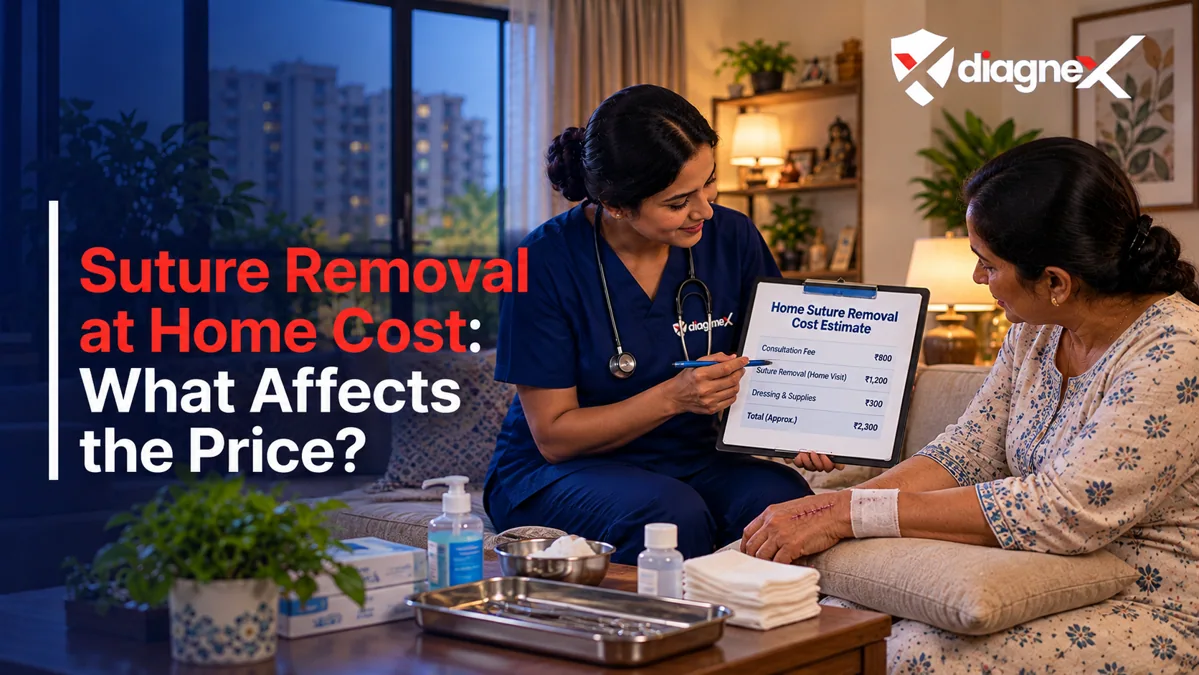
The cost of suture removal at home can vary because the visit is not always limited to cutting and removing stitches. A proper home visit may also include wound assessment, checking for infection or wound separation, preparing the area, removing sutures or staples safely, applying adhesive strips or a dressing if needed, and documenting the wound after the procedure.
For related context, read IV Drip at Home Cost: What Changes the Price? and Wound Dressing at Home Cost: What Influences the Price?.
For related context, read IV Drip at Home Cost: What Changes the Price? and Wound Dressing at Home Cost: What Influences the Price?.
For families comparing stitch removal cost or staple removal cost, the most useful question is not only the price of the nurse home visit. It is also what the visit includes and whether the wound needs additional care.
Diagnex should confirm the final charge only after reviewing the actual requirement. The cost can depend on the closure type, number of sutures or staples, wound condition, locality, timing, dressing needs, and whether the patient also requires broader post-surgery support.
Why Suture Removal at Home Does Not Have One Fixed Price
Two patients may both need stitches removed, but the work involved can be very different.
A straightforward removal from a clean, well-healed incision is different from a visit where: • the wound needs detailed review; • some stitches appear embedded; • the incision is still draining; • only part of the sutures should be removed; • adhesive strips are required afterward; • a new dressing is needed; • staples rather than sutures are present; • the patient needs additional nursing support.
This is why a single headline price can be misleading.
The Main Factors That Affect Suture Removal at Home Cost
1. Number of Sutures or Staples
The number of closure points can affect how long the procedure takes. Removing a few sutures from a small incision is generally simpler than removing a long line of sutures or staples from a larger surgical wound.
The nurse should still assess the wound before and during removal rather than focusing only on speed.
2. Suture Removal Versus Staple Removal
Staple removal uses a specific staple-removal device, while suture removal uses appropriate sterile or clean instruments depending on the procedure plan.
The professional time may be similar in some cases, but the equipment and technique are different. Diagnex's Suture and Staple Removal service covers the relevant procedure pathway when closure removal has been advised.
3. Wound Condition
A well-healed incision is usually more straightforward than a wound with redness, swelling, drainage, pain, bleeding, or partial separation. For more on the practical service arrangements, review surgery dressing at home before deciding what information the care team needs.
If the wound does not appear ready, the nurse may need to stop or delay removal and recommend medical review. A more complex wound can therefore involve more clinical time than a routine removal visit.
4. Dressing Required After Removal
Some wounds can remain uncovered after removal. Others may need adhesive strips, a light dressing, or continued wound care.
If dressing materials or wound-care consumables are required, these can affect the overall cost. Diagnex's Wound Care and Dressing service may be relevant when dressing continues after the sutures or staples are removed.
5. Nurse Visit Duration
The total visit time can vary according to wound location, number of sutures or staples, ease of removal, wound assessment, patient positioning, and whether additional dressing is needed.
A straightforward procedure may be relatively quick. A wound requiring careful review, partial removal, redressing, or escalation can take longer.
6. Patient Location
Home healthcare includes travel as well as clinical time. The patient's locality, travel distance, traffic conditions, and service coverage can influence availability and the final quote.
For repeated visits, location can have a greater effect on total care cost than it does for a one-time procedure.
7. Timing and Urgency
Same-day, urgent, early-morning, late-evening, or time-specific requests may be priced differently from a routine scheduled visit because staffing and travel arrangements can be more difficult.
Families should mention timing requirements while requesting the quote.
8. Whether Other Nursing Care Is Needed
Some patients need only suture removal. Others may also require wound dressing, injections, medicine administration, catheter care, monitoring, or mobility support.
When multiple nursing needs exist, Home Nursing Services may be more practical than arranging each clinical task separately.
What Is Usually Included in a Suture Removal Visit?
The exact scope should be confirmed before booking. A typical nurse visit may include: • review of the removal instructions; • wound assessment; • hand hygiene and procedure preparation; • suture or staple removal; • inspection of the wound during removal; • application of adhesive strips or a simple dressing if clinically indicated; • advice on wound protection and warning signs; • documentation of the procedure.
Consumables, specialised dressings, additional procedures, or doctor review may be separate depending on the service arrangement.
What May Be Charged Separately?
Depending on the case, separate costs can arise from: • dressing materials; • advanced wound-care products; • additional wound dressing; • doctor consultation; • urgent scheduling; • travel outside standard service coverage; • repeat visits if only some sutures or staples are removed initially; • broader post-operative nursing.
Patients recovering from surgery who need multiple types of support may find Post-Operative Care at Home more relevant than booking isolated procedures one by one.
Does Staple Removal Cost More Than Stitch Removal?
Not necessarily. Staple removal cost and stitch removal cost depend on the actual procedure, visit duration, wound condition, number of closure points, and whether additional care is required.
The presence of staples alone does not automatically mean the visit will cost more. What matters is the total clinical requirement. If the family is considering support at home, the Diagnex guide to home nursing explains the service pathway and its limits.
Does the Number of Stitches Change the Cost?
It can. A larger number of stitches may increase procedure time, but stitch count should not be treated as the only pricing factor.
A small number of difficult or embedded sutures may require more time than a larger number of easily accessible stitches in a well-healed wound.
Can the Cost Increase if the Wound Is Not Ready?
If the wound is not ready for complete removal, the visit may become a wound review rather than a straightforward removal.
The nurse may advise: • leaving some sutures or staples in place; • applying a dressing; • using adhesive strips; • arranging another visit; • contacting the surgeon or treating doctor.
The purpose of the visit should remain safe wound care rather than completing removal simply because a procedure was booked.
What if the Patient Needs a Doctor Review?
A doctor may be needed if the wound is opening, becoming increasingly red or painful, draining pus, bleeding significantly, or showing another concerning change.
In selected situations, a Doctor at Home consultation may be appropriate. More urgent or severe deterioration may require hospital assessment instead.
A doctor consultation, if required, should be considered separately from the basic suture-removal nurse visit.
How Post-Surgery Care Can Affect the Overall Cost
Suture removal is often only one small part of recovery after surgery.
The total care requirement may also include: • repeated wound dressing; • drain care; • injections; • medicine administration; • mobility assistance; • vital-sign monitoring; • pressure-area care; • follow-up nursing.
A patient with several ongoing needs may require a broader care plan rather than a one-time procedure. This is one reason the total post-surgery care cost can be different from the suture-removal charge alone.
How to Compare Suture Removal Quotes Properly
When comparing providers, ask: • Is the nurse home visit included? • Is wound assessment included? • Are basic consumables included? • Is dressing after removal included? • Is travel included? • Does staple removal use the correct dedicated instrument? • Are urgent timing charges separate? • What happens if only part of the sutures or staples can be removed? • Is a repeat visit charged separately? • Can the provider coordinate further wound care if needed?
A clear quote is more useful than comparing only the lowest advertised number.
Why Choosing Only by Price Can Be Misleading
Suture removal involves judging whether the wound is ready, recognising infection or separation, and stopping when removal is unsafe.
A lower price is not useful if the visit does not include proper wound review or if the patient is advised to proceed despite concerning signs.
The goal should be appropriate clinical care at a transparent price.
What Information Is Needed for an Accurate Quote?
Before requesting the cost, keep the following information ready: • whether the patient has sutures or staples; • number of stitches or staples if known; • wound location; • date of surgery or injury; • removal date advised by the treating team; • current wound condition; • whether dressing is still required; • locality; • preferred visit timing; • whether additional nursing support is needed.
Sharing accurate information helps the provider estimate the visit more realistically.
How to Request Suture Removal Cost From Diagnex
To request a suture removal at home cost estimate, share the procedure details, wound location, removal date, closure type, locality, and whether any dressing or additional nursing support is required. For care planning beyond this article, compare wound care at home with the instructions already given by the treating professional.
Diagnex can review the requirement and route the enquiry through the appropriate Clinical Procedures at Home pathway based on the procedure, locality, professional requirement, and available clinical information.
For a service quote and booking coordination, use the Diagnex Contact page.
Frequently asked questions
What affects suture removal at home cost?
The main factors are the number and type of sutures or staples, wound condition, visit duration, dressing needs, locality, timing, and whether additional nursing care is required.
Is staple removal cost different from stitch removal cost?
It can be, but not automatically. The total clinical requirement and visit complexity matter more than the closure type alone.
Are dressing materials included in the price?
This depends on the service arrangement. Basic or specialised dressing materials may be included, supplied by the family, or charged separately.
Can the nurse charge change if the wound is not ready?
The visit scope may change if the wound needs review, partial removal, redressing, or another visit. The provider should explain any additional cost before further care is arranged.
Is a doctor consultation included in the suture removal cost?
Not necessarily. A doctor consultation, if clinically required, may be a separate service from the nurse procedure visit.
Can Diagnex give a quote before the visit?
A quote can be more accurate when the closure type, wound location, removal date, locality, dressing requirement, and current wound condition are known.
Pricing Note
This article explains the factors that influence suture removal at home cost and does not publish a fixed Diagnex tariff. The final service charge should be confirmed for the individual requirement because procedure complexity, locality, timing, dressing needs, and additional care can vary.
Related Diagnex services and guides
Explore the Clinical Procedures service pathway and the Clinical Procedures article library for more information.
Diagnex publishes general healthcare information to support care planning. Individual decisions about diagnosis, prescriptions and treatment remain with the treating professional. Read our medical content policy and editorial standards.